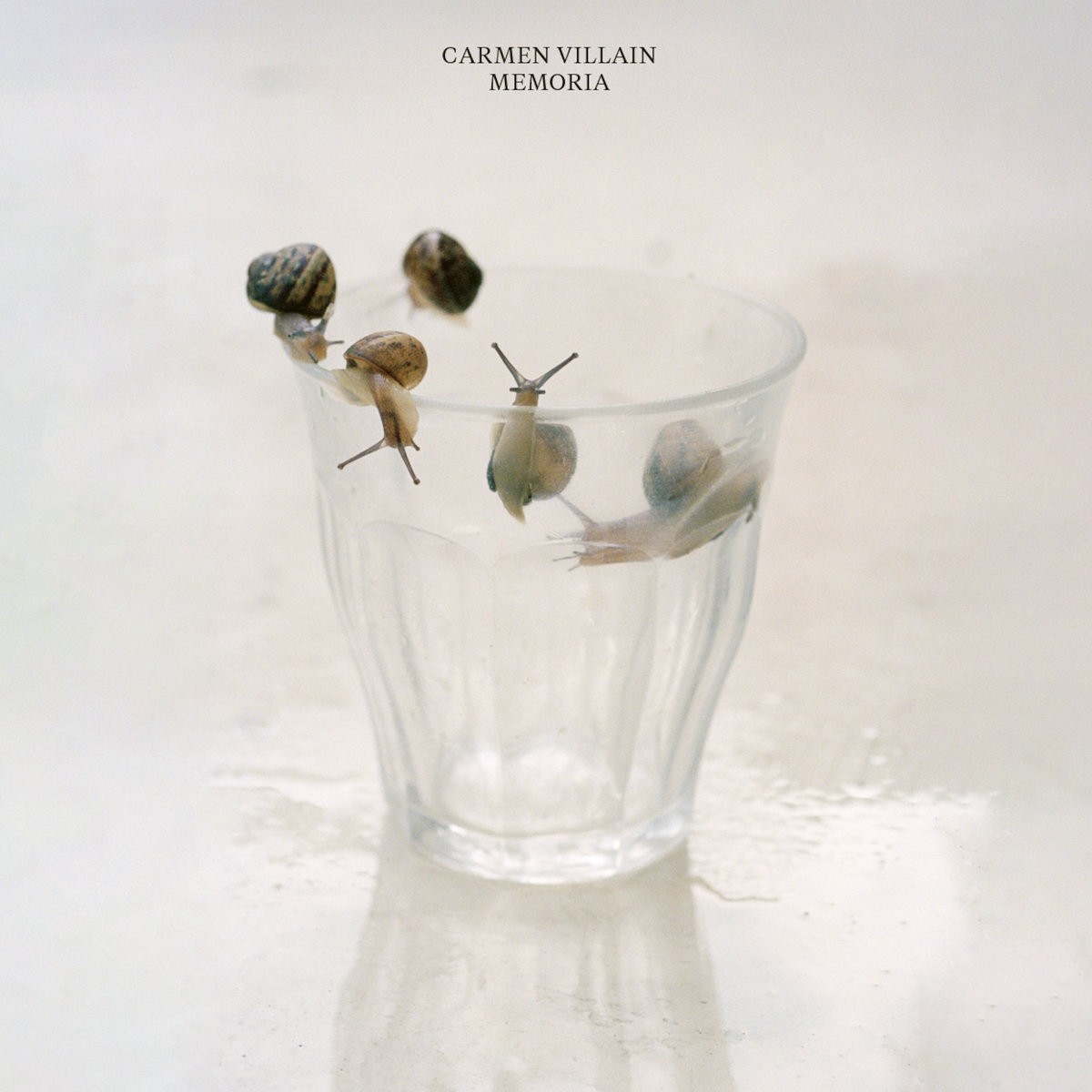
Spectral dub meets deep listening on Carmen Villain's fifth album, a patient and unforgiving study in sonic decay.


Memory is a lossy format. Every time you recall a sound - a voice, a room, the pitch of a specific silence - you're not retrieving a stored file but reconstructing it, smearing it slightly, losing a little resolution you'll never recover. Carmen Villain has built her fifth album around this idea with a rigour that borders on the philosophical, and Memoria lands as her most exacting and rewarding record to date.
The album's conceptual anchors are plainly cited: Pauline Oliveros's writings on internally recalled sound ("music no one else can hear, reshaped a little each time it's summoned"), and Apichatpong Weerasethakul's 2021 film of the same name, which uses unexplained sonic hallucinations to probe the porousness of memory. These aren't academic references dropped for credibility - they're structural blueprints. The seven tracks on Memoria function not as discrete compositions but as successive degradations of the same sonic material, each one allowing its predecessor to dissolve into it before offering itself up for the same treatment.
The instrumentation is deliberately fragile: flute (Johanna Orellana), trumpet (Eivind Lønning), and Villain's own clarinet. But these aren't recorded with the warmth or presence you'd associate with an acoustic session - they arrive as though half-remembered, softened by IRCAM ambisonic spatialisation work that turns the stereo field into something shifting and permeable. It recalls the Jon Hassell and Brian Eno Fourth World project in spirit, or the spectral trumpet of Nils Petter Molvær, except Villain is less interested in exotica than in dissolution. The instruments don't so much play as appear and recede.
Against these fragile textures, the bass is something else entirely. On "Entre Nosotros," it arrives "less as a note than as a blunt object" - a low, amorphous thud with a mechanical clank that buries everything that came before it under grinding, tectonic weight. "Blue" pushes this further still, with bass lines that buckle and stutter, closer to Rhythm & Sound's dub minimalism than to anything conventionally melodic. The lineage to early Burial-adjacent work and to Ricardo Villalobos's more extreme loop explorations is audible, though Memoria never quite settles into club music's anchoring pulse; it uses dub architecture to create not movement but suspension.
This is a harder album than 2022's Only Love from Now On, which operated in a sunlit, spectral haze. Memoria pushes that same instinct somewhere less welcoming - more demanding, more willing to sit in discomfort. "Hope Synapses" is perhaps the closest thing to a pause for breath, but even there the mood is muted, the melodic gestures surfacing and slipping before they can establish themselves. The closing bookend pieces, "Holding a Shape" and "Omriss," complete the record's slow arc toward formlessness with a patience that will test the inattentive listener and reward everyone else.
The difficulty is the point. Carmen Villain is asking you to sit with sound the way you sit with a half-remembered dream - knowing that the act of attending to it is also the act of changing it. Memoria doesn't resolve. It evaporates, leaving the impression that you heard something important without being able to say exactly what.


;)
;)
;)
;)
Enter your email address below to stay up to date with Absolute Loss new and announcements.

© Absolute Loss 2026.