The Virus story starts in Germany in the mid-90s, when the Clavia Nord Lead landed and rewired what a lot of producers thought a "virtual analogue" synth could sound like. Christoph Kemper, inspired by what Nord had done, teamed up with Guido Kirsch to build their own take on it. The first Virus, the Virus A, was unveiled at Musikmesse Frankfurt in 1997 and sold out its first run fast. What followed was over a decade of steady iteration - the B, the Indigo, the C - each one pushing polyphony, filter design, and sound quality further, all built around the same core idea: model the character of analogue synthesis using DSP, without the tuning drift, the maintenance, or the price tag of vintage hardware.
The TI, released in 2005, was the big leap. Two DSP chips instead of one, real integration with your DAW via USB (TI stands for "Total Integration"), and a significantly expanded oscillator set - Hypersaw, wavetable, granular and formant oscillators sitting alongside the classic Virus analogue modelling. It's the twin filter design that really made the Virus what it is though. Two independently routable multimode filters, which can run in series or parallel, meant you could do things like stack a 4-pole and 2-pole filter to fake an 18dB/octave slope, or chain them for a 36dB/octave sound that basically nothing else at the price point could touch. Combine that with a modulation matrix deep enough that almost any parameter can modulate almost any other parameter - including modulating itself - and you've got a synth that rewards obsessive programming as much as it rewards just turning a knob and leaning into a preset.


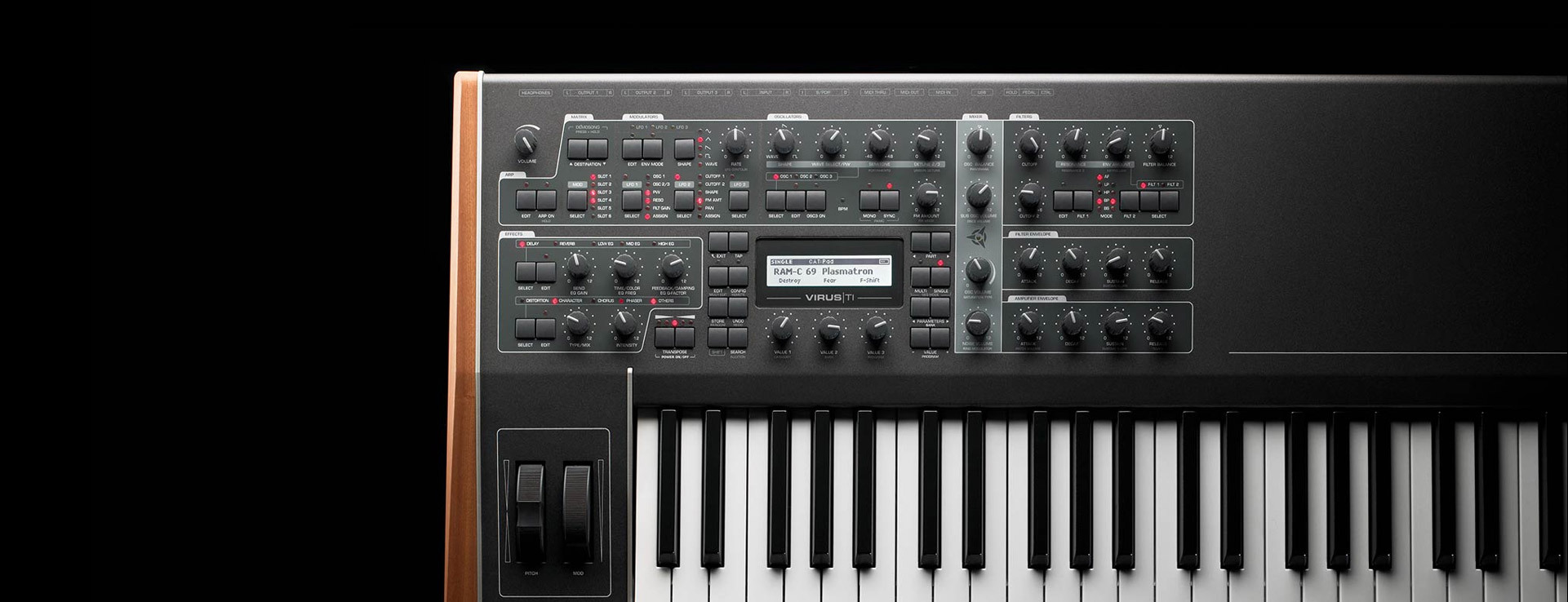 © Access


;)
![Irrelevant [VM] 2xCD](https://cdn.shopify.com/s/files/1/0268/3754/9248/products/vm1.jpg?v=1602235738');)
;)
;)
